Vacuum Bags vs Storage Bins: Which Works Better for Small Closets?
A practical comparison of vacuum bags, rigid bins and fabric storage bags for seasonal bedding and small closets—with a decision guide and five measurements to take first.

Short answer: Use vacuum storage bags for bulky, compressible bedding you will not need often. Choose rigid bins when you need protection from crushing and easy stacking. Choose breathable fabric bags for textiles you access more regularly or do not want tightly compressed. The right choice depends on the item, the storage location, and how often you need it—not on a universal “best” organizer.
Quick comparison: vacuum bags, bins, and fabric bags
| Storage method | Best use | Main advantage | Main trade-off |
|---|---|---|---|
| Vacuum compression bags | Bulky comforters, spare bedding, suitable soft textiles | Reduces volume of compressible items | Slow access; compression is not suitable for everything |
| Rigid plastic bins | Mixed items, items needing structure, stackable storage | Easy labeling and repeat access | Fixed volume, even when partly empty |
| Fabric zippered bags | Seasonal clothes and linens accessed occasionally | Flexible shape and simple access | Little or no compression; protection varies by material |
When vacuum bags are the right choice
Vacuum bags work best when a bulky textile takes up more shelf or closet volume than its weight or frequency of use justifies. Spare comforters, guest bedding, and some seasonal linens are good candidates. You fill the bag, close the seal, and remove air using the compatible pump or vacuum attachment. The goal is to make a compressible bundle easier to store, not to make it weightless.
The Spacesaver Jumbo 6 Pack with Hand Pump (Amazon ASIN B00X8KSKF6) is a concrete example. Its Amazon.com listing identifies six jumbo bags, a hand pump, a double-zip closure, and a triple-seal valve. These are listing specifications, not results of independent durability testing. Before ordering, check the current Amazon listing for size, included accessories, and any changes to the selected variation.
When you should avoid compression
Do not automatically compress delicate, structured, or specialty garments. Items with shaped shoulders, rigid inserts, or loft that needs to be preserved may not be appropriate. Follow the care label and the storage guidance for the particular material. If you are unsure, use a non-compression method instead.
Compression is also inconvenient for items you reach for every week. Reopening, finding one item, and resealing the rest may cost more time than a simple labeled bin. A bag can lose compression if its seal is not properly closed or is damaged, so do not plan storage around a guaranteed final thickness.
When rigid bins are better
Rigid bins are easier to stack predictably and make sense for mixed supplies, frequently used seasonal decorations, or objects that should not be squeezed. Clear bins can improve visibility; opaque bins may look neater on open shelves. Either way, label the front and measure the bin's external dimensions, including handles and lid, rather than relying on advertised capacity alone.
Check the actual shelf width and depth, the space needed to lift the lid, and whether the stack will remain stable. A bin that fits a shelf but cannot be pulled out comfortably is not a good small-space solution.
When fabric bags are better
Fabric zippered bags can be useful for folded sweaters, linens, and other soft goods that need organization more than compression. Handles and flexible sides can make them easier to move in and out of a closet. But do not assume a fabric bag is waterproof, airtight, or pest-proof unless the specific manufacturer documents those properties.
Five measurements to take before buying
- Available opening: measure the closet door or under-bed clearance, not just the storage cavity.
- Usable depth: allow room for handles, hinges, trim, and nearby furniture.
- Height after packing: do not assume a vacuum bag will always reach the advertised compression level.
- Access frequency: daily and weekly items belong in easier-to-open storage.
- Weight and lifting: compressed bedding still weighs the same; plan for safe retrieval.
Common mistakes to avoid
- Storing textiles before they are clean and fully dry.
- Putting every fabric into a compression bag without checking its care requirements.
- Buying a bin based only on liters or gallons instead of outside dimensions.
- Blocking vents, access panels, doors, or safe walking routes with storage stacks.
- Assuming a “space-saving” claim guarantees a particular percentage reduction for your items.
Decision guide for a small apartment
One bulky spare comforter? Consider a vacuum bag if the care instructions allow compression and you need it only occasionally. A mixed collection of small items? A labeled rigid bin is likely easier. Folded clothes you rotate seasonally? A fabric bag may provide enough organization without compression. Items accessed every few days? Prioritize an open shelf or easily opened bin instead of vacuum storage.
For more room-by-room ideas, see 7 smart storage ideas for small apartments. For a wider look at the site's currently catalogued products, read 5 Amazon-verified storage finds compared.
Editorial methodology: This guide compares storage approaches based on fit, access, and material care. The Spacesaver product identity and six-pack configuration were checked against its Amazon.com listing on October 20, 2026. We have not independently tested the product, and we make no current price or availability claim. Product links may earn us a commission on qualifying purchases.
Products in this guide
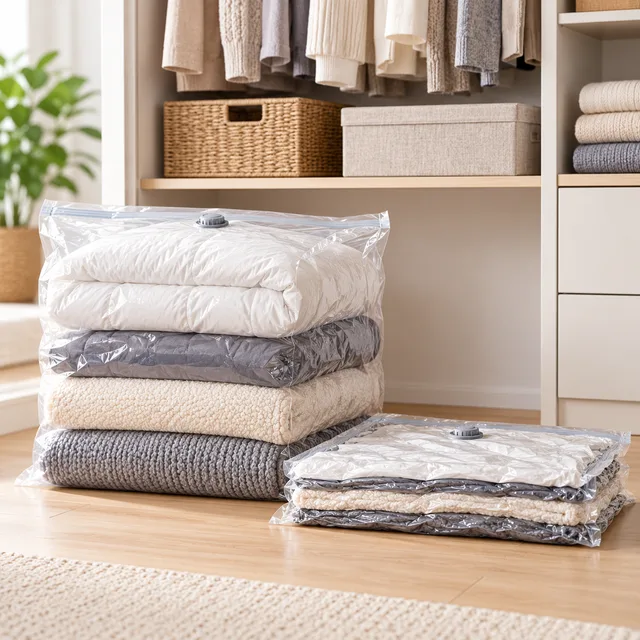 Illustrative image — not an exact product photo
Spacesaver Vacuum Storage Bags with Hand Pump, Jumbo, 6 Pack
Six jumbo vacuum-compression storage bags with a hand pump for seasonal bedding, comforters and soft clothing.
Best For: Compressing bulky comforters, seasonal clothes and bedding when closet or under-bed space is limited